
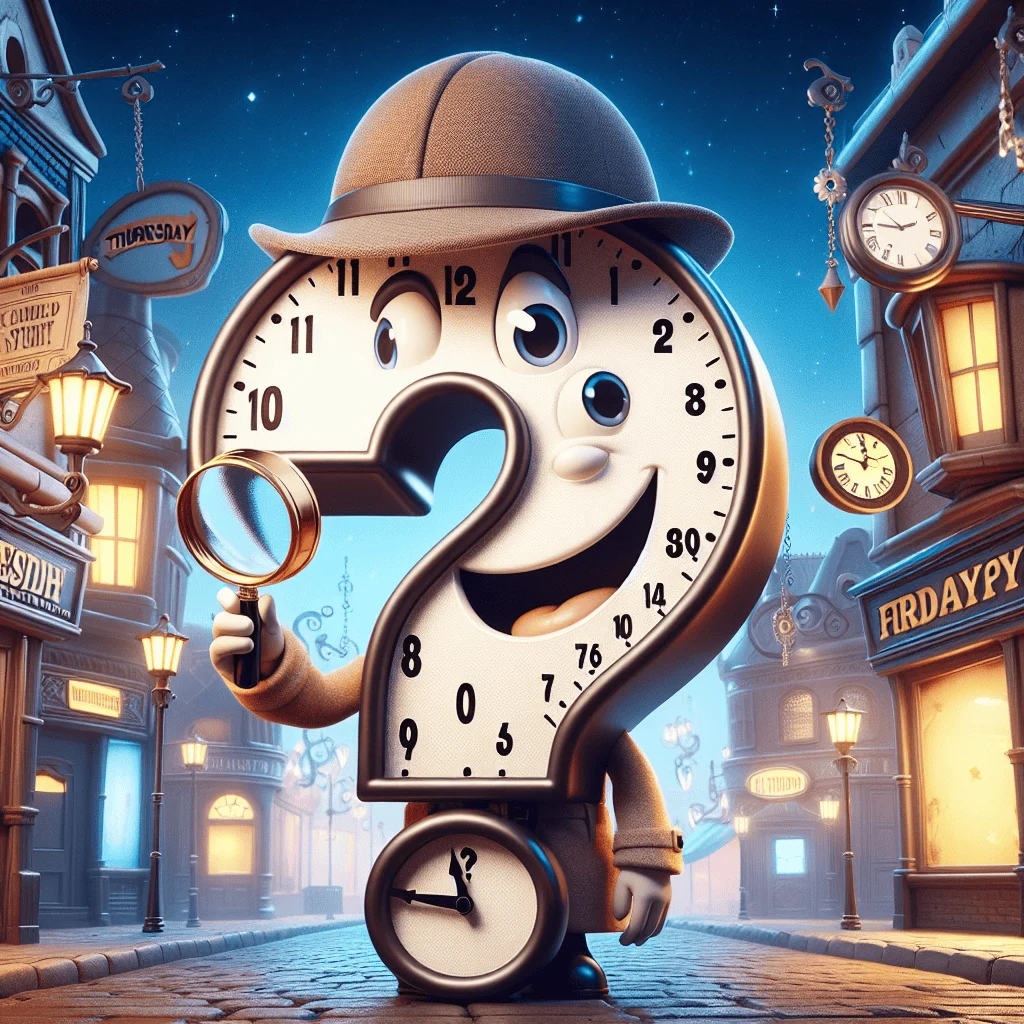
Riddle: When does Friday come before Thursday?
Answer: When you read the dictionary
Riddle Explanation + Meaning
This riddle can seem a bit tricky at first glance.
Normally, in a week, Thursday comes before Friday.
But the riddle isn't talking about days of the week in their usual order.
Instead, it's talking about the order of words in a dictionary.
In the English language, words are arranged alphabetically in a dictionary.
Since the word "Friday" starts with the letter "F" and the word "Thursday" starts with the letter "T", "Friday" comes before "Thursday" in a dictionary.
This is a playful way to think about word order and the alphabetical system, rather than the calendar week.
It challenges us to think outside of our usual understanding of how days follow each other.
Liked this riddle? Keep going with our Friday riddles for the whole family, the riddles about words with answers, our riddles about months for the whole family and the classic “Christmas before Thanksgiving” riddle.
Why the answer is in the dictionary
The riddle uses "before" in a way we rarely think about. When you hear Friday and Thursday together, your mind goes straight to the calendar, where Thursday always comes first. But "before" can also mean earlier in a list. In alphabetical order, F comes before T, so any list sorted by letter, like a dictionary or an index, puts Friday ahead of Thursday. Riddles like this are a good reminder that the same word can live in two worlds at once. "Friday" is both a day you wait for all week and a string of six letters. Once you see the letters, the calendar stops mattering, and the answer feels almost too simple.
The misleading part is that days of the week feel like they can only mean time. There is also a second answer that works. Friday of this week comes before Thursday of next week, so on any calendar, a Friday is followed by a Thursday six days later. Both answers are fair, and it is fun to let kids find the second one on their own after they hear the first.
Where this riddle comes from
This is a classic word riddle of unknown origin, part of a family built on alphabetical order. The same trick shows up with months, holidays, and numbers, which makes it easy for teachers to adapt when practicing dictionary skills.
3 more riddles like this one
What word becomes shorter when you add two letters to it?
Hint
Answer
Which word is always spelled wrong in the dictionary?
Hint
Answer
What is the longest word in the dictionary?
Hint
Answer
How to solve riddles like this
- When a riddle mentions order, ask "in what list?" It might be alphabetical, not by time.
- Treat names of days, months, and holidays as words made of letters, not just dates.
- Look for a second answer that is also true. Good riddles often have one.
- Say the question slowly and notice which word has more than one meaning.